10/08/2011

Bio and Reviews

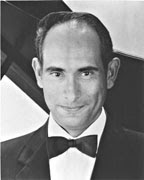
CHARLES  FIERRO                                   
  Concert Pianist

     One of Southern California's leading pianists, Charles Fierro has made concert tours for the National Endowment for the Arts and the California Arts Council and has performed numerous concertos with orchestras.  He has appeared at the National Gallery of Art and Dumbarton Oaks Foundation in Washington, D.C. and at the Palace of Fontainebleau in France on the invitation of the legendary musician, Nadia Boulanger.  He has interpreted the music of Beethoven, Schumann and Liszt at the Ojai Festivals.  He has given the American premieres of many important new works, performing more than a dozen times at the prestigious Monday Evening Concerts in Los Angeles.

     His debut for Nonesuch Records was named “Critics’ Choice” for five consecutive months by High Fidelity Magazine.  His recording of the piano music of Aaron Copland was made under the auspices of the composer himself.  For Delos International, he has recorded MacDowell's Sonata Eroica and Twelve Virtuoso Etudes. For Nonesuch, he has recorded MacDowell's Keltic Sonata, Sea Pieces, and Woodland Sketches and the world premiere recording of MacDowell's First Modern Suite.

     He is Professor Emeritus of Music at California State University Northridge, where he received the Distinguished Professor Award.  He is well-known for his master classes and adjudications at universities and conventions.  He has taught at the Image International Music Festival and served on the Board of Directors of the Paderewski Music Society.  He is the author of numerous published articles on musical subjects, including music reviews which have appeared in the international press. 

Charles Fierro studied with Lillian Steuber, Joanna Graudan and Adele Marcus and was closely associated with composer Ingolf Dahl, whose major piano works he has recorded.  He holds a Doctorate of Music “with Distinction” from the University of Southern California. 

Review :  Los Angeles Times

“To play all these works in one session is a formidable undertaking and Fierro met the challenge with massive authority and assurance.   His technique was at all times unimpeachable; the most difficult demands were mastered effortlessly.  He stirred up immense storms of sound and was equally successful in realizing the most evanescent tonal effects.  It was a strikingly impressive exhibition of piano playing as well as of musical comprehension.”

"Under his hands the music sings."   On Stage Magazine, Houston
"Intense, artistic sensitivity"   Musical  America
"Consistent virtuosity and expressiveness"    New York Times
"Fierro rises superbly to the music's brilliance with showy pianistic
   colors."     Performing Arts Magazine
"Pianists should possess a style of refinement similar to Fierro's."
                                                                                          Washington Post
"Commitment, virtuosity and passion in abundance"
                                                                               Los Angeles Daily News
"The highlight of our convention"     California Association of Professional Music Teachers

Article:  THE MUSIC OF PAUL HINDEMITH

A Giant of 20th-Century Music

by Charles Fierro
                   
When he first appeared on the European musical scene in the 1920s, Paul Hindemith (1895-1963) amazed listeners with the kinetic energy and freewheeling dissonances of his compositions.  An anti-Romantic attitude gave his early music an “expressionist” edge.  In his ironic Suite 1922, for example, he treats the piano like a machine, applying “abrasive arrogance” (Glenn Gould’s characterization) to popular dances like the Shimmy, Boston and Ragtime.  His iconoclastic Kammermusik series for diverse virtuoso ensembles toppled traditional notions of beauty.  During the same period, however, he produced  the witty Wind Quintet and the affecting song cycle, “Das Marienleben". 
 
In his middle thirties, as his artistic philosophy matured, Hindemith made a drastic change in his style of composition.  (Here we may recall that, at a similar age, Beethoven declared, "I am not content with my work up to now; from here on I intend to follow a different path.")  Hindemith moved from shocking listeners to communicating with them. "Music," he insisted, "despite its tendency toward abstraction, is basically a means of communication.  Composers and performers have a social responsibility to be comprehensible." 

While some composers abandoned standard harmonic practice in search for new source materials, Hindemith, instead, single-handedly undertook the renewal of the entire tonal system, expanding its boundaries enormously.  To accomplish this, he placed the art of music on a foundation of natural principles, in particular, the overtone series and the psycho-acoustic facts of sound perception.  In his groundbreaking book, The Craft of Musical Composition, he proposed that the materials of music are not only the seven-note diatonic scale and its chromatic alterations, but that all twelve notes of an octave can legitimately be derived from a fundamental tone and are therefore related to it.  “Tonality”, he declared, “is a natural force, like gravity.  It cannot be suspended for long without engendering confusion in the listener.”

In his theory and in his music, Hindemith found a personal way to utilize the full spectrum of “chromatic” resource while retaining conventional notions of tension and release, dissonance and resolution.  Above all, he affirmed the primacy of the major triad as a symbol and expression of order.  He employed strategically related key areas for subsidiary themes and structural relationships. This organization gives his music perspective, a third dimension like that in representational painting. 

Of course, adherence to a system, no matter how comprehensive and natural, does not guarantee results, nor does technical know-how substitute for ideas.  Hindemith was, in fact, a fountain of ideas.  Like Mozart, he composed quickly, yet his music is perfectly crafted in every detail and shows no sign of haste. 

He believed that music has the ethical power to affect human character, and that listeners have the ability to use their musical experiences for the betterment of the world.  He organized sound successions to reflect the harmony of mind and body, the beauty of mathematical proportions and even the laws that govern the cosmos.  His music abounds with a feeling of health and optimism.  Without sermonizing, it tends toward no less a goal than the moral improvement of humanity by attempting to align the human spirit with the harmony of the heavens. 

Hindemith wrote a great deal of music, but even if he had not composed a note, he would be one of the giants of 20th-century music.  His contributions to the theory and philosophy of music have universal validity, but it is the power of his compositions themselves that continues to reach us emotionally.  “Neo-Baroque”, “neo-classical” and other reductionist labels do not do justice to the striking individuality and significance of his work. 

One reason for the comprehensibility of his music is its clear relationship to tradition, especially the counterpoint of J.S. Bach, Beethoven’s technique of motivic derivation, the pianistic textures of Brahms, Schumann’s chains of dotted rhythms, the open fourths and fifths of early Renaissance style.  Pedal points, sequences and characterisic modal cadences establish a "grammar" that creates logic as well as surprise.  Hindemith's music is immediately identifiable; it sounds like nobody else's. 

We also relate to his music because its moods and forms (“cheerful”, “solemn”, “energetic”, “pastorale”, “march” etc.) are familiar from our life experience and because even his most complicated pieces retain an essential vocal connection. (First-time listeners to his compositions are often surprised to find how tuneful they are.)  In his book, A Composer’s World (which I highly recommend), he writes: “Whatever a pianist does, using intellect, hands and lever arrangements in the process of enlivening musical forms, will always be derived from musical experiences with the human voice.  If pianists want to move listeners intellectually and emotionally, they would better stay close to the conditions of vocal expression. Even in prestissimo tone successions, so easily produced by faultlessly working keyboards, the reference to the basic musical material of the singing voice should always be recognizable.”    

Throughout his professional life, Hindemith was committed to education. He taught at a number of institutions of higher learning, including Yale University.  His finest works, like the Sinfonia Serena, Concert Music for Strings and Brass and the ballet Nobilissima Visione, attain a high degree of inspiration and are in no sense "academic".  His Symphony Mathis der Maler and the Symphonic Metamorphoses on Themes of Carl Maria von Weber retain perennial popularity precisely because of his brilliant use of melody, continuity, metric rhythm and tonality.  In his judgment, the absence of these qualities in the music of his contemporaries led to a "barbarous" (his word) musical culture without a common language, a virtual Tower of Babel. 

In this context, the integrity of Hindemith’s music is more relevant than ever.  He believed in communication, but he also believed that there must be something important to communicate.  As he said in one of his lectures: "The inexhaustibility of artistic forms is the inexhaustibility of human thought itself.  If a musician has the gift of showing, with the means of expression related to his times and circumstances, a reflection of this inexhaustibility to his fellow-men and bringing into existence, together with them and on their behalf, a small universe, then he has fulfilled his artistic task." 

                            Copyright 2009